Here's the new fill-in calendar:
September 2011
Happy Back-to-school OR NOT-back-to-school, everyone.
We'll be homeschooling. Wish us luck! :-)
Showing posts with label writing. Show all posts
Showing posts with label writing. Show all posts
Very easy holiday cards


Draw (or have your child draw) a simple tree shape (a triangle over a small rectangle).
Cut construction paper (scraps left over from some other project are perfect) into tiny pieces, the smaller the better.
Starting at the bottom of the tree, apply glue row by row, put the paper pieces on, apply more glue, keep going until you're done.
Draw a tree-topper or make one from paper pieces.
Scribble a short note inside the card (write it on a piece of paper so your child could copy it).
Make as many cards as you need. Mail them to friends and family.

And here are the cards we made last year (with almost-4-yo.).
Scribble a snowman (or a Xmas tree). Use the stick-on foam mosaic pieces to decorate it.

December calendar template
Wow, is it December already!? Where did the year go?
If you came here looking for a calendar templates, this is your lucky day. Lots of snowflakes.
I promise to put some easy ideas for Holiday cards. We're working on them now.
Fill-in calendar December 2010
If you came here looking for a calendar templates, this is your lucky day. Lots of snowflakes.
I promise to put some easy ideas for Holiday cards. We're working on them now.
Fill-in calendar December 2010
October calendar template
Calendar Template
The monthly calendars became one of the favorite activities here. It gives kiddo a chance to practice counting and writing numbers (without her realizing the hidden agenda), and it gives her a chance to draw a picture and have it displayed on the fridge for a full month! It also helps her to get the concept of time. She does not need to ask "How many days till..." - now she just counts the days on the calendar. She can also figure out whether there is a school day or a weekend. See, I told you there's plenty of hidden agenda, yet she LOVES them.
So, for a few days she was reminding me that we need to print out a new calendar. And here it is. I finally figured out how to upload it somewhere, so you could also print out your own copy. Note that I only write the first and last day of the month, because I know that kiddo is capable of filling in the blanks. Add more numbers if your child is not yet comfortable writing all the numbers by himself.
Proper pencil grip in 3 easy steps
Teaching a child to hold a pencil correctly is important, and since you've landed here, you probably know that. This is the easiest way I've found so far. I did not invent it, I saw it in a japanese activity book for kids. Below are the pictures of me demonstrating the 3 easy steps. It works equally will for lefties.


If you're looking for more handwriting tools, I recommend checking out Handwriting without tears workbooks or for smaller kids getting one of the Grasshopper kits . Check out my earlier post on them here: "getting small hands ready for school".


If you're looking for more handwriting tools, I recommend checking out Handwriting without tears workbooks or for smaller kids getting one of the Grasshopper kits
. Check out my earlier post on them here: "getting small hands ready for school".
Printable calendar template

You can see that I wrote some of the dates, this is what is called "control of error", it allows a child to do the work independently (fill in the blanks), and to be able to check whether or not the numbers are in order. Depending on where your child is, you can write in as many numbers as needed. Filling in the blank spaces with flowers also gives a child a signal that they need to stop. You know that a 4yo will keep writing 32-33-34-etc. until she runs out of paper.
If you'd like, you can download my template to use at home. I'm not sure how I can "attach" a pdf, so the template is in jpg for now.
Calendar
"I never tried this today" "Are we there yet?" "Is it tomorrow now?" Small kids have no sense of time. Presenting them with a visual calendars seems to help a lot.
 We first started to make our calendars in December. There were simply too many things scheduled for little N. to keep track of: Birthday, Party (try to explain to a 4 yo why these two are not on the same day!), Holidays, School show, etc... So we made a Block calendar. We took a "post-it" block, counted out 31 pages. Then we helped N. to write the numbers on each page, and then we drew pictures that symbolized the event. It was a success. There were no more questions about "when" and "why not now". She also loved being in charge of the calendar, taking a leaf off every morning.
Now we do monthly calendars. With a space for a picture (either to color or to draw, depending on what we feel like). The order of the events and the idea of time are not the only things that kids learn when they make their own calendars. They can practice counting, writing, drawing or coloring; they learn days of the week and months. You can also count how many days are until the special event.
TIP: For the younger kids, fill in some of the numbers and/or use a yellow highlighter to write the numbers for them to trace.

Now we do monthly calendars. With a space for a picture (either to color or to draw, depending on what we feel like). The order of the events and the idea of time are not the only things that kids learn when they make their own calendars. They can practice counting, writing, drawing or coloring; they learn days of the week and months. You can also count how many days are until the special event.
TIP: For the younger kids, fill in some of the numbers and/or use a yellow highlighter to write the numbers for them to trace.
Getting small hands ready for school
Last year I went to a Hand Writing Without Tears workshop. It was an eye opening experience. They stressed out the importance of such things as crawling; coloring, using easels, playing with clay and blocks - because all of these activities help to develop hand muscles that will be important when it's time to get a pencil and start writing.
The program, created and widely used by OTs, has materials to help teach the child proper pencil grip, posture, proper letter formation and left to right order. This is not at all a Language Arts course, the goal of the program is to help children write correctly and fast. Did you know that improper letter formation can lead to a lower speed of writing and improper pencil grip can lead to achy hands? And slow speed and hand pain can lower your child's performance in middle and high school.
I would recommend their teachers book to everyone, especially if you are homeschooling. The materials are great for school or homeschool use, but they are not specifically geared towards parents and home use. For more information, visit www.hwtears.com and please do recommend them to your child's teacher.
 Grasshopper® kits on the other hand were designed for home use. They were created by Rachel Rudman, an OT with an advanced specialty in pediatrics. We met Rachel at the Toy Fair. The kits are not available for sale just yet, but will be this summer.
There are 4 colorful kits that are packed with simple playful activities to help small children develop small motor skills necessary for school all through play. There are no workbooks! The kits are recommended for children ages 3 to 5, but could be used with children as young as 18 months.
-kits 1 "ABCs and Simple shapes" and 2 "Following directions" come together and include a Grasshopper® no-spill carrying case with organized compartments and built-in easel. My favorite activity from this kit is a gel packet letter tracing: you slide a letter card inside a gel filled plastic pocket and then trace the letter.
-kit 3 "Getting out hands ready" has coloring and clay activities as well as hungry Mr. Crunch that likes to eat foam butterflies.
-kit 4 "Snip, Glue and Grow" contains 10 multi-sensory games and craft projects to improve fine motor skills. My favorite is a bubble blower!
For more information, visit grasshopperkits.com
(image source grasshopperkits.com)
The program, created and widely used by OTs, has materials to help teach the child proper pencil grip, posture, proper letter formation and left to right order. This is not at all a Language Arts course, the goal of the program is to help children write correctly and fast. Did you know that improper letter formation can lead to a lower speed of writing and improper pencil grip can lead to achy hands? And slow speed and hand pain can lower your child's performance in middle and high school.
I would recommend their teachers book to everyone, especially if you are homeschooling. The materials are great for school or homeschool use, but they are not specifically geared towards parents and home use. For more information, visit www.hwtears.com and please do recommend them to your child's teacher.

There are 4 colorful kits that are packed with simple playful activities to help small children develop small motor skills necessary for school all through play. There are no workbooks! The kits are recommended for children ages 3 to 5, but could be used with children as young as 18 months.
-kits 1 "ABCs and Simple shapes" and 2 "Following directions" come together and include a Grasshopper® no-spill carrying case with organized compartments and built-in easel. My favorite activity from this kit is a gel packet letter tracing: you slide a letter card inside a gel filled plastic pocket and then trace the letter.
-kit 3 "Getting out hands ready" has coloring and clay activities as well as hungry Mr. Crunch that likes to eat foam butterflies.
-kit 4 "Snip, Glue and Grow" contains 10 multi-sensory games and craft projects to improve fine motor skills. My favorite is a bubble blower!
For more information, visit grasshopperkits.com
(image source grasshopperkits.com)
Learning to read
English was a second language for me. We learned it at school, but after we learned to read in Russian. The way we were taught was also very different. So now, when the time came to teach N. how to read, I look for any help I can get. Sometimes I even wish there was a class for parents "Teaching your child to read 101".
N. already knows all the letter sounds and can read 3 letter words, but as I read somewhere, in order to be good readers kids need to be able to recall the letter sounds almost automatically, without thinking too much. That means they need a lot of practice. So were are on a lookout for some fun resources.
 I came across the FREE all-in-one Phonics program online - Progressive Phonics. There are mini books that you read WITH your child (on screen or print out), word writing worksheets, word search puzzles, games and more.
Handwriting is an important part of Progressive Phonics, and for good reason: many educators are returning to basics -- reading AND writing -- as the key to literacy. Simply put, when children write what they learn, they learn it better.
The underlying reason has roots in physiology: when we write, we activate kinesthetic (motion) memory, which is the earliest, strongest and some say the most reliable memory channel. Furthermore, writing takes more time than reading a word, giving the brain ten to twenty times more exposure to a word.
The mini-books also introduce kids to the Sight words - aka the Dolch List. The list consist of 220 commonly used words many of which cannot be sounded out, so children need to recognize them by sight in order to achieve reading fluency.
We're really excited to add Progressive Phonics to our reading practice materials. N. seems to like them more than mini books (Bob Books for example), that we also use.
N. already knows all the letter sounds and can read 3 letter words, but as I read somewhere, in order to be good readers kids need to be able to recall the letter sounds almost automatically, without thinking too much. That means they need a lot of practice. So were are on a lookout for some fun resources.
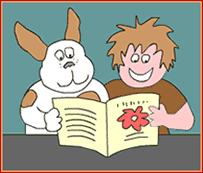
Handwriting is an important part of Progressive Phonics, and for good reason: many educators are returning to basics -- reading AND writing -- as the key to literacy. Simply put, when children write what they learn, they learn it better.
The underlying reason has roots in physiology: when we write, we activate kinesthetic (motion) memory, which is the earliest, strongest and some say the most reliable memory channel. Furthermore, writing takes more time than reading a word, giving the brain ten to twenty times more exposure to a word.
The mini-books also introduce kids to the Sight words - aka the Dolch List. The list consist of 220 commonly used words many of which cannot be sounded out, so children need to recognize them by sight in order to achieve reading fluency.
We're really excited to add Progressive Phonics to our reading practice materials. N. seems to like them more than mini books (Bob Books for example), that we also use.


